The $48k Serverless Trap: Why jmail.world Blew Up (Literally & Financially)
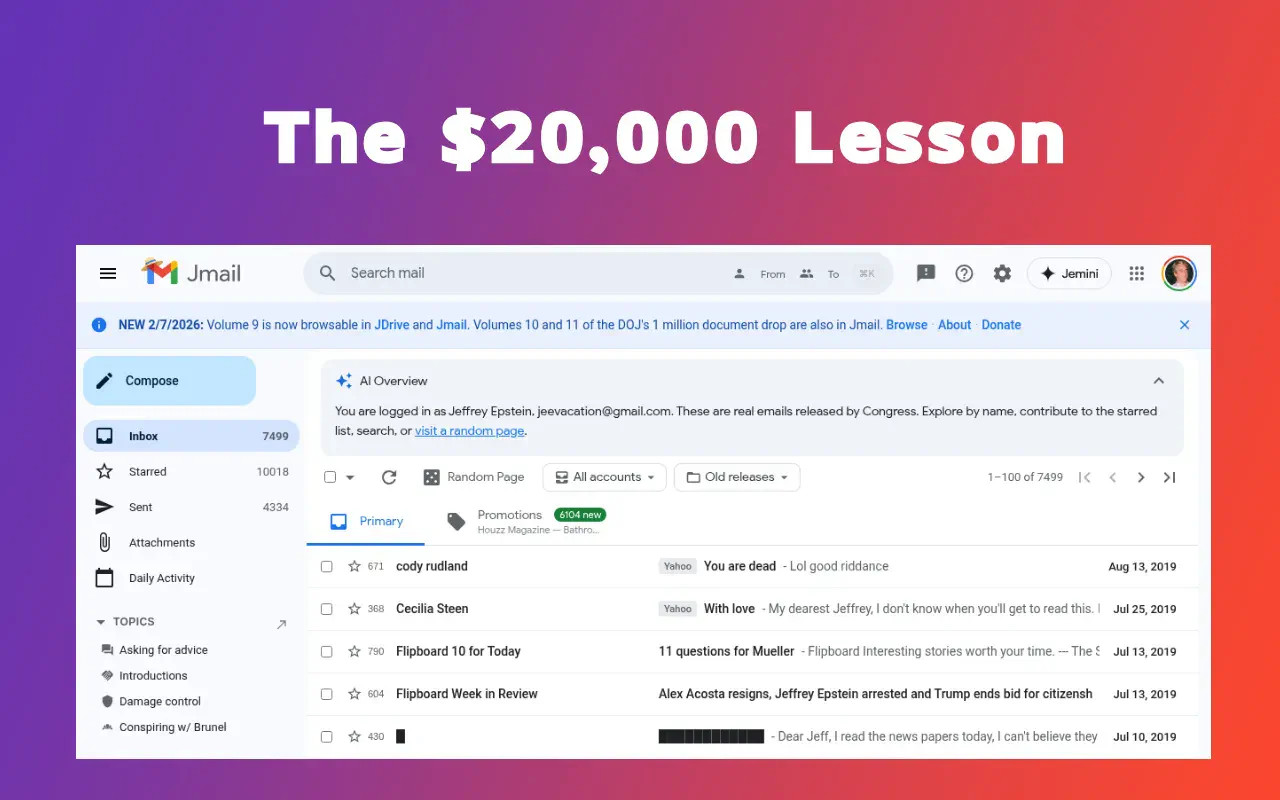
The internet just witnessed a financial car crash in slow motion.
Jmail.world, the viral site that cloned the Gmail interface to make the Jeffrey Epstein email archive searchable, became a victim of its own success. In just two months, the project pulled in over 450 million pageviews. For most devs, that’s the dream. For the Jmail team, it was a $48,000 nightmare.
The Math of a Disaster
The site was built using a “Serverless” architecture (specifically Next.js on Vercel). Every time a curious user clicked an email or searched a name, a tiny cloud function fired up.
The Bill: $48,000 (Vercel hosting and bandwidth/compute).
The Donations: $28,000 (Crowdfunded by the community).
The Gap: A $20,000 hole in the pockets of the creators/sponsor.
Vercel’s CEO, Guillermo Rauch, eventually stepped in to cover the bill as a “public interest” gesture, but the lesson for the rest of us is clear: Serverless is a luxury you can’t afford at scale.
The “Bro Stack”: How to beat the $48k Bill
If you’re building the next big archive—whether it’s Jmail, JDrive, or JPhotos. You don’t need a $50,000 budget. You just need to stop paying for “compute” and start using “static” storage.
1. Ditch the Server, Use the Edge
The secret to hosting 200M+ visitors for the price of a gym membership is React + Vite + Cloudflare R2.
Instead of a server “thinking” every time someone clicks, you pre-generate your data as JSON files and dump them into a storage bucket.
2. The Death of Egress Fees
The biggest killer in the Jmail bill wasn’t just the CPU time; it was the Egress Fees (paying for data to leave the server) and compute cost. Cloudflare R2 has $0 Egress.
Whether 10 people or 100 million people download a PDF/photos from your “JDrive,” the bandwidth cost is exactly the same: Zero.
3. The New “Suite” Budget
Here is what the “Jmail Suite” looks like if you build it the smart way:
| Feature | Old Way (Serverless) | The New Way (React + R2) |
|---|---|---|
| Hosting | ~$48,000 | $25 (Cloudflare Pages) |
| Storage (300GB) | $$$ (Tiered) | $4.35 (Flat rate) |
| Operations | Infinite (Pay per click) | ~$360 (1B Read Ops) |
| Bandwidth | $0.15/GB | $0 (Always free) |
| TOTAL | $48,000+ | $385 to $1000 |
If you use Cloudflare’s Cache, that $360 bill drops even further… potentially to under $200. By moving the “brain” of the app from the cloud to the user’s own browser, you turn a $50,000-a-month operation into a hobby project.
Jmail proved that people want access to massive data. Now it’s time to prove we can host it without going broke.